Africanized honeybees, widely established across the Sonoran Desert since the mid-1990s, defend nests with an alarm radius up to 100 feet and react ten times faster than domestic European strains. In residential…
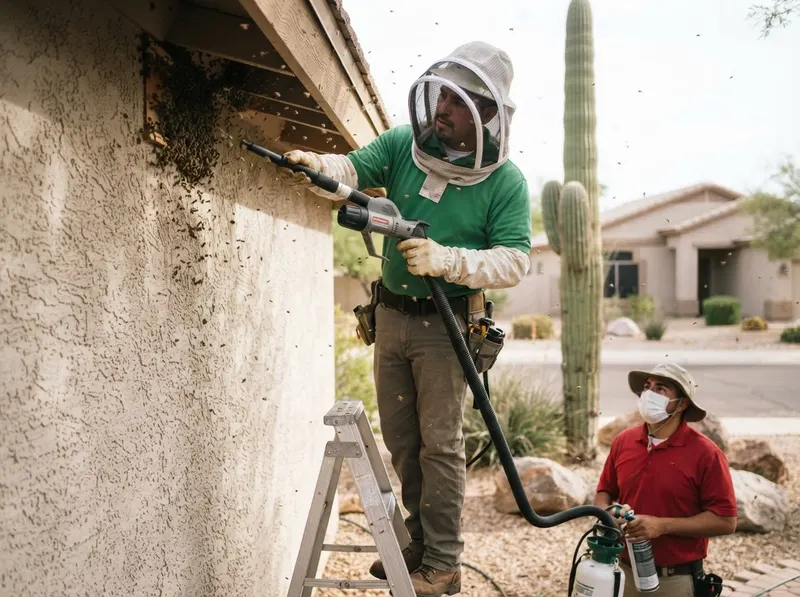
Africanized honeybees, widely established across the Sonoran Desert since the mid-1990s, defend nests with an alarm radius up to 100 feet and react ten times faster than domestic European strains. In residential corridors like Arcadia and North Central Phoenix, mature citrus groves and hollowed olive trees offer ideal nesting voids. Further south near the South Mountain Park and Preserve perimeter in Ahwatukee Foothills, desert paper wasps build under overhanging clay tile roofs and stucco eaves. If a colony establishes inside an attic, irrigation valve box, or block-wall fence weep hole, immediate structural exclusion becomes mandatory. Attempting to spray an active Africanized colony with store-bought aerosol canisters triggers a hyper-defensive swarm response capable of pursuing targets for over a quarter-mile.
Decision-fit for stinging insect management centers on colony duration versus nesting location. A resting migratory swarm clustered exposed on an oleander branch or block wall requires a direct knockdown treatment without structural surgery. Conversely, a colony active for more than 72 hours inside exterior fascia, parapet walls, or chimney cavities requires a complete cutout. Leaving wax comb and unsealed honey inside interior drywall invites secondary pest cascades, including carpet beetles, black roaches, and roof rats, while fermenting honey stains ceilings within two weeks during 110-degree summer heat. The operational trade-off rests between surface barrier treatments and invasive structural openings: surface treatments resolve raw wasp clusters beneath eaves, but full wall cutouts are essential whenever bees enter sub-roof architectural voids.
Technicians carry out removal in four sequenced phases. Phase 1 maps flight lines, entry crevices, and defensive perimeters using thermal or acoustic sensors. Phase 2 applies localized knockdown agents while fully suited in heavy-gauge mesh armor to secure the immediate safety zone. Phase 3 physically extracts the nest structure, stripping every square inch of comb, brood, and honey reserves from wall studs or tree hollows. Phase 4 seals the void using metal mesh and copper mesh backing, finishing with an enzymatic wash to neutralize the lingering isopentyl acetate alarm pheromone. Properties in Maryvale, Encanto Village, and the Willo Historic District featuring older brick chimneys and lath-and-plaster crawlspaces undergo thorough entry-point caulking to halt recurrent colony establishment.
Every job gets a firm, written price after a free on-site visit.
Tell us about your africanized bee and desert wasp removal job in Phoenix and we'll send a clear, written quote, usually the same day.
 Copper Cactus Pest Control