Sonoran desert bark scorpions require specialized mechanical exclusion because standard liquid pyrethroids fail against their thick chitinous cuticles and elevated travel paths. Unlike ground-dwelling desert hairy…
Sonoran desert bark scorpions require specialized mechanical exclusion because standard liquid pyrethroids fail against their thick chitinous cuticles and elevated travel paths. Unlike ground-dwelling desert hairy scorpions, bark scorpions climb textured surfaces such as raw block fencing, stucco weep screeds, and interior framing. A property located along the granite foothills of South Mountain Park and Preserve or near citrus groves in Arcadia faces sustained migration pressure from deep block-wall expansion joints. Physical exclusion seals the structural envelope using copper mesh, silicone-acrylic caulking, and exterior weatherstripping on door sweeps. Sealing gaps down to 1.5 millimeters prevents access beneath bottom plate framing, while dusting attic floor perimeters stops ceiling-fixture drops into master bedrooms and cribs.
Decision guidance depends on the structural age and construction style of the property. For a mid-century brick ranch in the Willo Historic District or Encanto Village, historical mortar erosion and original wood-frame casement windows create multiple access paths; comprehensive exclusion work sealing sub-floor vent screens and window tracks is necessary before perimeter sprays show measurable efficacy. Conversely, newer track construction in Desert Ridge or Ahwatukee Foothills requires heavy attention to the weep screed at the base of exterior stucco, where foundation settling opens channels directly into wall voids. The operational trade-off centers on cost versus longevity: chemical applications alone temporarily suppress secondary insect food supplies like crickets, but fail to stop scorpions from entering during July monsoon humidity spikes unless structural gaps are physically sealed.
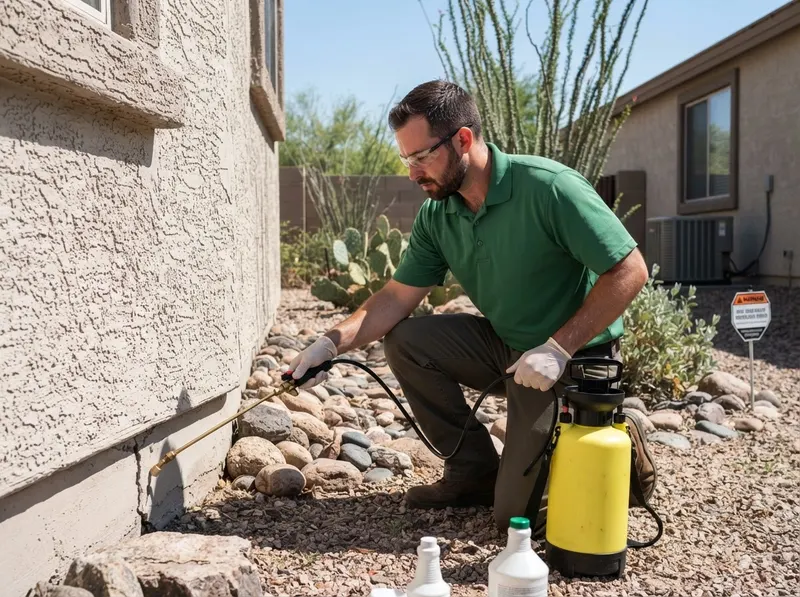
Technicians treat weep screeds, block-wall pilasters, plumbing penetrations beneath sinks, and the foundation perimeter up to 3 vertical feet. Interior applications utilize EPA-registered microencapsulated products that cling to the pest's walking legs without breaking down under 115-degree Valley surface heat. Treatments dry completely within 60 to 90 minutes, rendering baseboards inert and safe for domestic pets and small children. Every protocol begins with an exterior mapping phase to isolate irrigation boxes, river rock landscaping, and low-lying vegetation adjacent to the home's stem wall.
Every job gets a firm, written price after a free on-site visit.
Tell us about your bark scorpion extermination and exclusion job in Phoenix and we'll send a clear, written quote, usually the same day.
 Copper Cactus Pest Control