Sonoran desert ants present two distinct structural threats to Maricopa County properties. Native desert fire ants (Solenopsis xyloni) construct extensive subterranean foraging tunnels across sun-baked turf, decomposed…
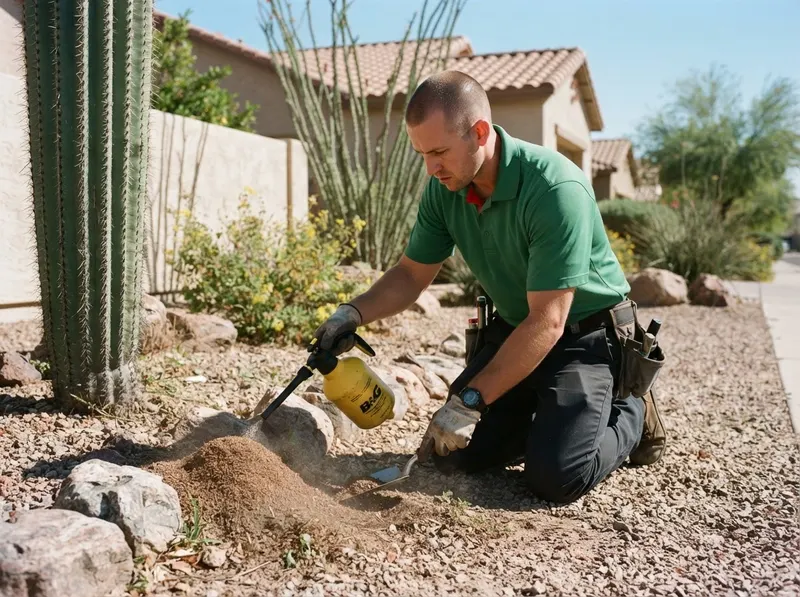
Sonoran desert ants present two distinct structural threats to Maricopa County properties. Native desert fire ants (Solenopsis xyloni) construct extensive subterranean foraging tunnels across sun-baked turf, decomposed granite, and expansion joints around pool decks. Unlike common nuisance species, fire ants aggressively defend colonies through painful sting clusters that risk allergic reactions in family members and pets. In historic irrigation corridors like Arcadia and the Willo Historic District, continuous flood-irrigation cycles saturate subterranean soil, driving fire ant colonies directly toward elevated stem walls and home foundations. Meanwhile, desert carpenter ants (Camponotus vicinus) establish parent nests outdoors in decaying mesquite stumps or landscape ties, dispatching foragers indoors to hollow out sound structural framing around bath traps, roof valleys, and kitchen plumbing chases. The primary trade-off between standard surface barrier applications and targeted ant management lies in bait acceptance versus mechanical repelling: generic over-the-counter pyrethroid sprays scatter worker ants into secondary satellite colonies through budding, whereas non-repellent transfer chemistry allows worker ants to carry active bait matrix directly to queens buried up to 4 feet subterranean.
Effective ant remediation relies on precise structural diagnosis and climate-timed application windows. Along block-wall property perimeters in North Central Phoenix, Maryvale, and Encanto Village, masonry voids create cooler thermal buffer zones where carpenter ants construct massive nocturnal runway systems. If foraging trails lead from desert wash vegetation near South Mountain Park and Preserve or Ahwatukee Foothills properties, exterior non-repellent liquid bands establish an undetectable residual zone that workers walk through and transfer during grooming. Step 1: Technicians inspect the exterior foundation, hardscaping, and moisture sources like drip-irrigation emitters and air-conditioning condensation lines. Step 2: Specialized macro-crystalline granular ant baits are deployed directly along structural foraging lines, matching specific nutritional cycles between protein-seeking phases and carbohydrate cravings. Step 3: Interior plumbing voids and electrical conduits with suspected nesting cavities receive low-pressure aerosolized or dust formulations to collapse interior satellite nests without dispersing pests deeper into structural cavities. In master-planned developments like Desert Ridge and the Biltmore Area, managing high-heat exposure requires heat-stable bait matrices that remain palatable despite 115-degree ground temperatures.
Every job gets a firm, written price after a free on-site visit.
Tell us about your desert fire ant and carpenter ant control job in Phoenix and we'll send a clear, written quote, usually the same day.
 Copper Cactus Pest Control