Residential rooftop solar installations create a sheltered 4-to-8-inch sub-panel microclimate that buffers Sonoran desert heat. During triple-digit summer afternoons, temperatures directly under solar panels can stay…
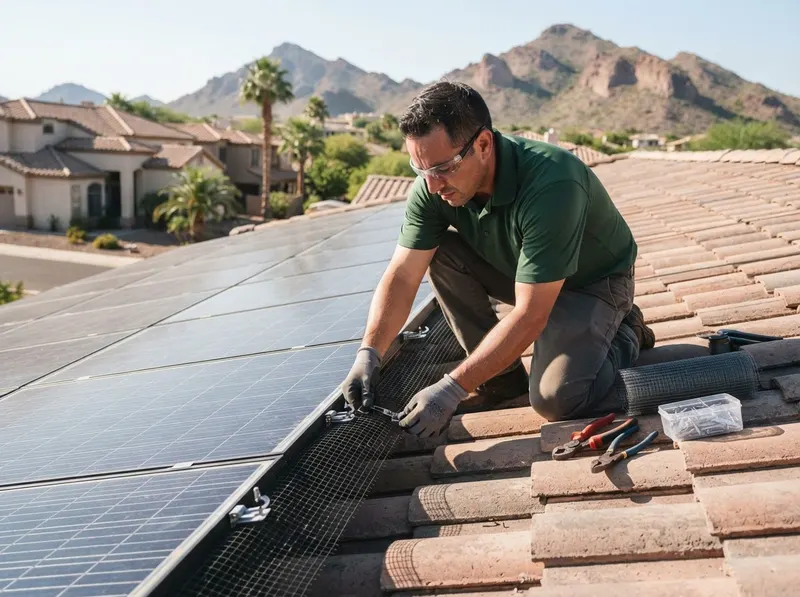
Residential rooftop solar installations create a sheltered 4-to-8-inch sub-panel microclimate that buffers Sonoran desert heat. During triple-digit summer afternoons, temperatures directly under solar panels can stay 15 to 20 degrees cooler than exposed roof tile, attracting feral pigeons seeking nesting harborage. In neighborhoods like Arcadia, Desert Ridge, and the Ahwatukee Foothills, nesting pigeons deposit uric-acid-heavy droppings that corrode aluminum frames, occlude solar cell exposure, and chew sensor wiring. A standard barrier installation utilizes UV-stabilized, non-drilling nylon or stainless-steel tension clips that anchor black PVC-coated wire mesh tightly against the panel flange and roof contour. This process preserves the factory warranty on photovoltaic modules because it requires zero drilling into panel frames or tile underlayment.
Property owners evaluating exclusion methods often weigh plastic netting or visual plastic raptor decoys against rigid steel exclusion screens. Plastic bird netting degrades rapidly when exposed to 115-degree Valley surface heat, sagging within two seasons and trapping debris, while synthetic plastic owls produce zero deterrent effect on urbanized flocks once birds habituate to static placements. Rigid galvanized mesh presents an upfront structural trade-off: it requires specialized access ladders and ladder stabilizers to scale pitched concrete tile or historic clay roofs in areas like the Willo Historic District or Encanto Village, but it delivers a permanent physical block against biological entry. Cleanout is step one: clearing existing dried guano and nesting straw beneath the modules with HEPA-filtered collection tools. Step two involves custom-cutting the steel mesh to match concrete tile valleys, flat tile crowns, or standing-seam metal profiles. Step three anchors the tension clips every 12 to 18 inches along the module perimeter to eliminate deflection gaps wider than three-quarters of an inch.
Solar proofing is distinct from general open-air bird dispersal or toxic baiting. Structural exclusion does not rely on transient chemical sprays that wash away during sudden July monsoon cloudbursts, nor does it leave toxic hazards near outdoor pets or family swimming pools. Where homes sit near major agricultural or water features, such as North Central Phoenix irrigation laterals or Papago Park flyways, pressure from displaced flocks remains constant year-round. Installations on complex, multi-tiered roofs in the Biltmore Area or expansive ranch layouts in Maryvale require individual elevation planning to account for split inverter arrays and conduit runs, ensuring that wiring conduits leading to the main service panel remain completely enclosed against rodent and bird entry.
Every job gets a firm, written price after a free on-site visit.
Tell us about your pigeon and pest bird solar panel proofing job in Phoenix and we'll send a clear, written quote, usually the same day.
 Copper Cactus Pest Control